Ksiaz Castle History: From Piast Fortress To Palace
Ksiaz Castle began as a Piast border fortress in 1288 and ended up as one of the largest castles in Poland, a Hochberg palace, and a Nazi excavation site, all in the same walls.
Short answer
Ksiaz Castle was built between 1288 and 1292 by Duke Bolko I the Strict and first documented in 1293. The Hochberg family held it from 1509 until the Nazi seizure, when it was absorbed into Project Riese from 1943 to 1945. Today the City of Walbrzych owns it, and a castle-plus-tunnels visit costs from 92 PLN.
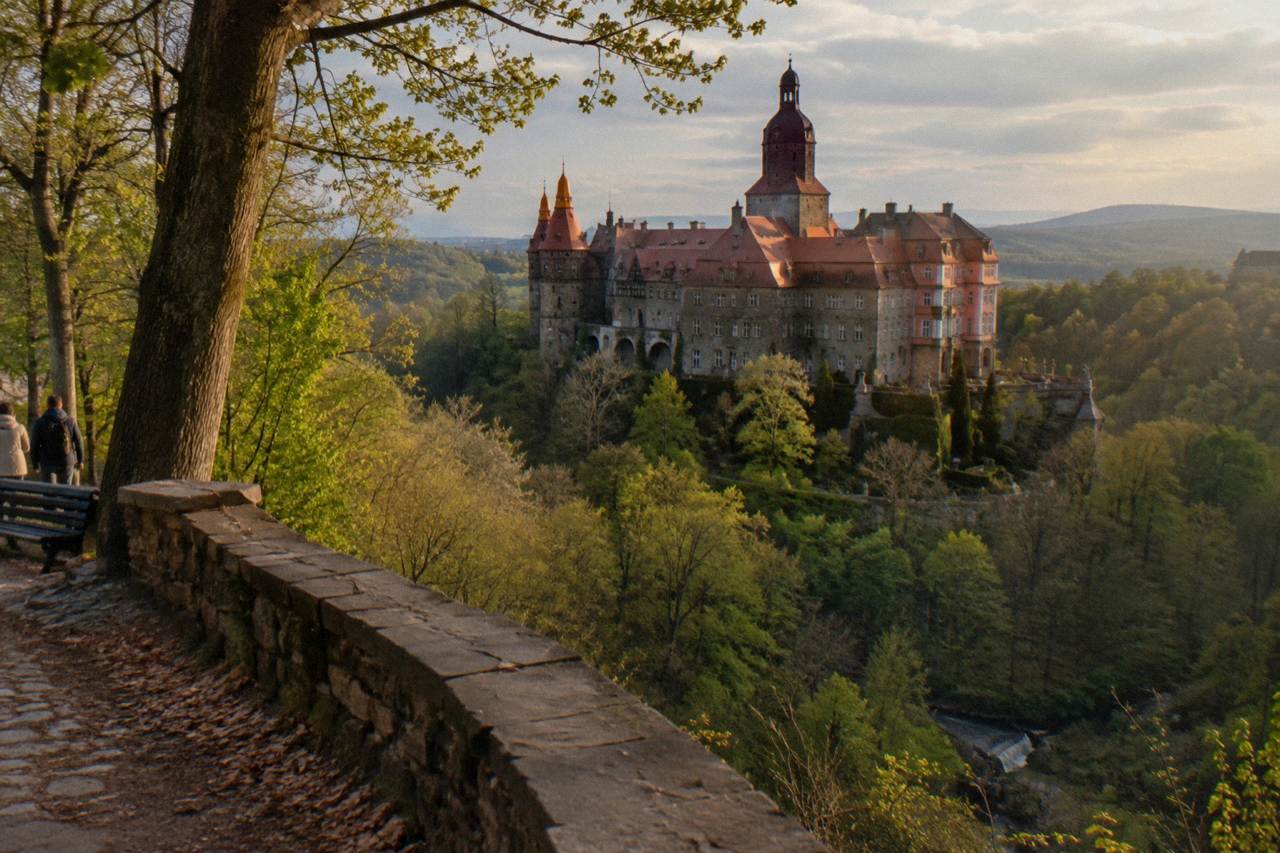
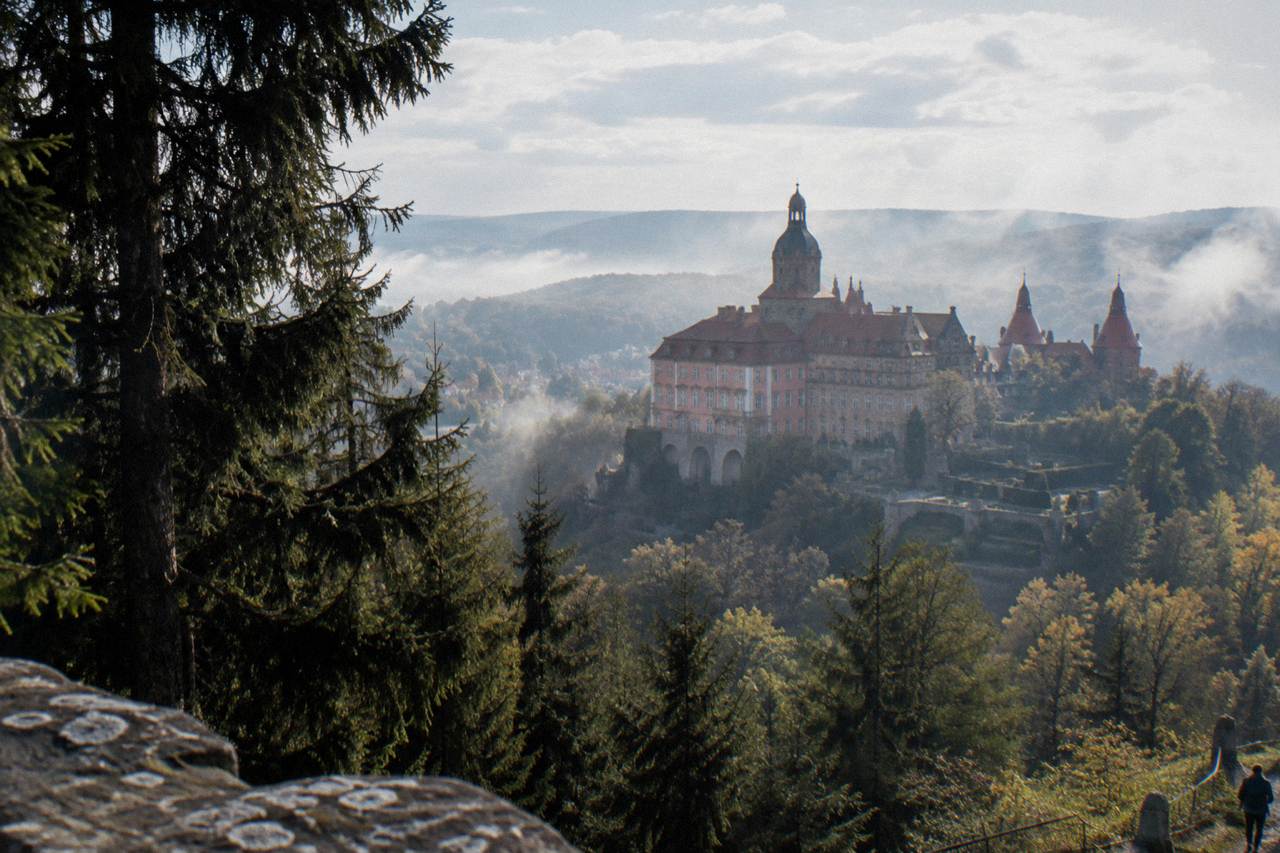
Ksiaz Castle rises out of a wooded cliff above the city of Walbrzych, roughly 70 km southwest of Wroclaw, and almost nothing about its silhouette is what it originally was. What Bolko I the Strict began as a stone border fortress in 1288 is now a sprawling palace complex of roughly 400 rooms and about 11,000 square metres, the largest castle in Silesia and the third-largest in Poland after Malbork and Wawel. Its German name, Schloss Furstenstein, still appears on old maps and photographs, a reminder that this building changed hands between Polish dukes, Bohemian crowns, Habsburg emperors, Prussian industrialists and Nazi planners without ever moving an inch.
The castle's history explains why a single visit can involve a baroque interior, a terraced garden laid out for a British-born princess, and a concrete-lined tunnel dug by concentration-camp labourers. That layering is the point. This guide walks through the whole timeline, names the people who shaped the building, and ends with the practical question every history reader eventually asks: which tour actually shows you these layers in a single day. Ksiaz Castle Tours exists precisely because the story is easier to follow with a plan.
Who Built Ksiaz Castle And When?
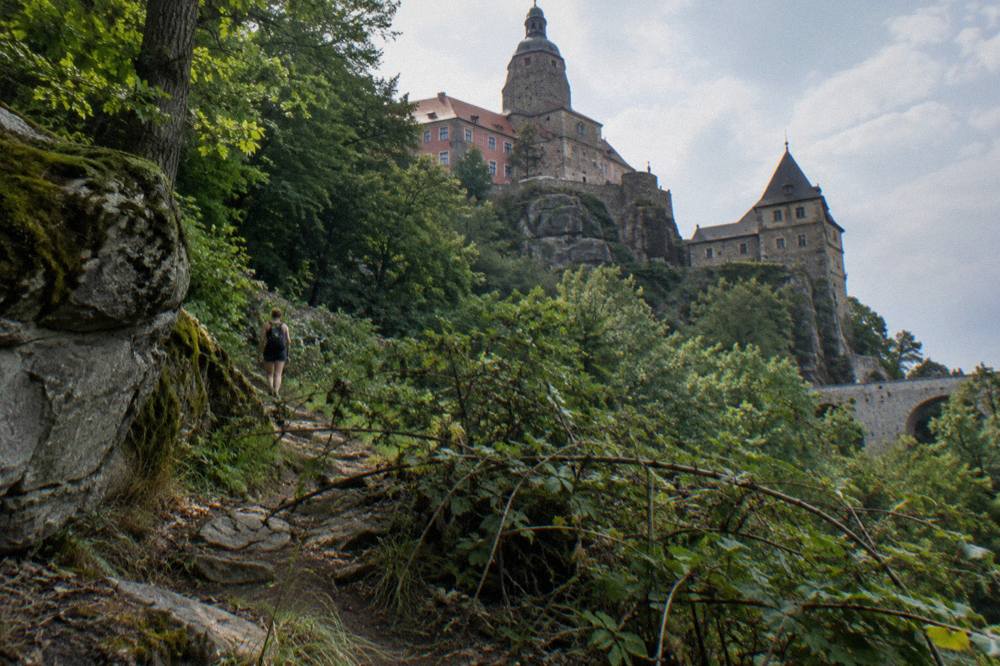
Ksiaz Castle was built between 1288 and 1292 by Duke Bolko I the Strict, a ruler of the Piast dynasty, making him the founder of the fortress. The castle's existence was first confirmed in writing in 1293, when the stronghold appeared in a documented record for the first time. Bolko raised it to guard the southwestern border of his Silesian duchy, and the site, a rocky spur above a bend in the Pelcznica valley, gave the garrison a natural defensive advantage that the masonry only reinforced. Few visible traces of that first fortress survive above ground today, because every later owner rebuilt over or around it.
The medieval centuries after Bolko were turbulent. The castle passed through Bohemian overlordship and changed hands repeatedly as Silesian duchies fragmented and were absorbed into the Lands of the Bohemian Crown. Fortified border positions like Ksiaz were prizes in every regional conflict, and the building was repeatedly damaged, repaired and extended in step with the wars around it. By the late medieval period it had already grown well beyond a single watchtower into a multi-wing complex.
What a visitor sees in the courtyard today is mostly the result of later waves of work: the baroque and neoclassical remodellings of successive generations, and the restorations that followed wartime damage. The layered plan is best understood before arrival, and the castle interior tour routes guide maps which rooms belong to which era. Visitors short on time can compare options in the half day or full day trip planner.
The table below gives the fixed dates that every historian of the castle agrees on:
| Year | Event |
|---|---|
| 1288 to 1292 | Bolko I the Strict builds the fortress |
| 1293 | First written documentation of Ksiaz |
| 1509 | Konrad I Hochberg acquires the estate |
| 1943 to 1945 | Project Riese tunnelling under the castle |
| Today | Owned by the City of Walbrzych, run by a municipal company |
What Role Did The Hochberg Family Play?
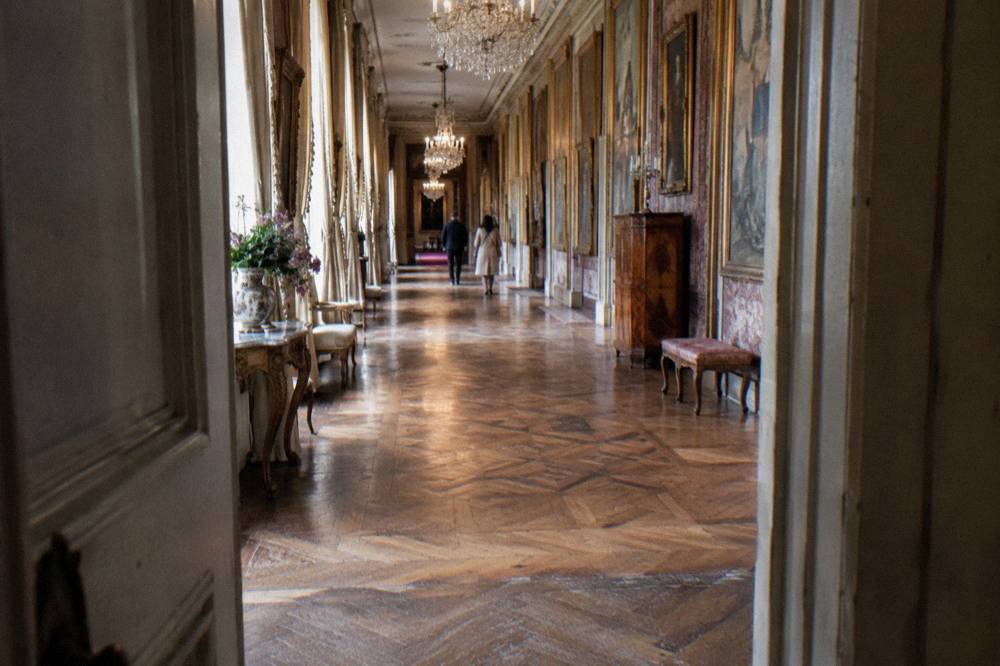
The Hochbergs played a defining role in the story of Ksiaz, taking ownership in 1509 when Konrad I Hochberg acquired the estate and holding it for more than four centuries. During that long tenure, the property was transformed from a defensive castle into a residential palace. Under the Hochbergs the building acquired its grand staircase, its baroque interiors and eventually its character as a pleasure seat for one of Silesia's richest aristocratic dynasties, whose wealth came substantially from Prussian court connections and regional industry. That long tenure is the single most important fact in the castle's architectural story.
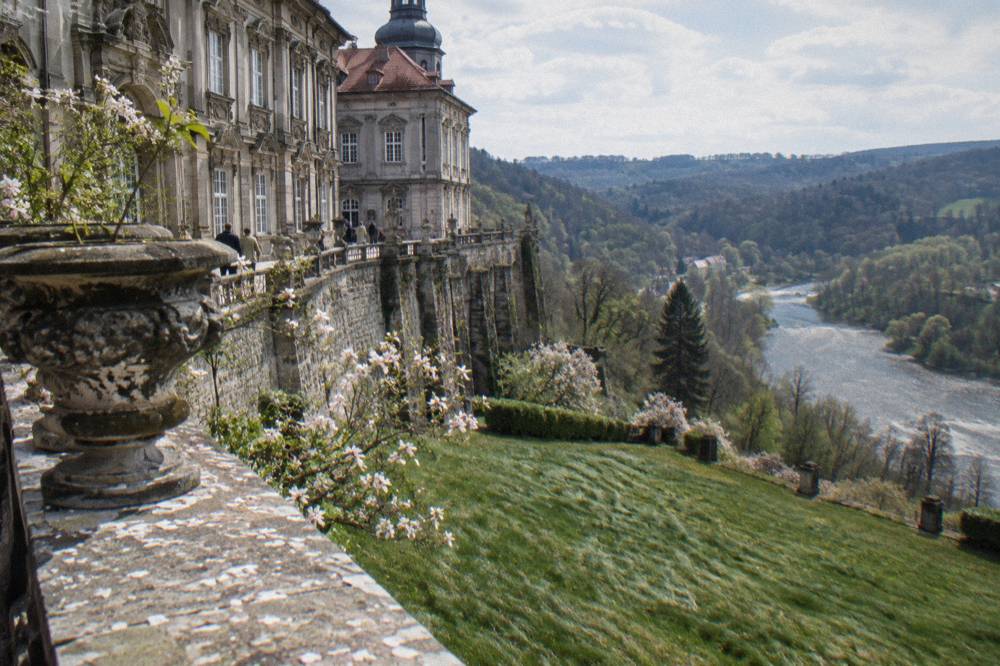
The family's dominance matters because it explains the castle's architecture. A fortress has thick walls and few windows; a dynasty that expects to entertain needs ballrooms, terraces and orangery-style gardens. Successive Hochberg generations rebuilt according to the fashion of their day, which is why the complex mixes medieval footprints with baroque facades and romantic historicist touches. The terraces on the valley side, now one of the castle's signature features, belong firmly to this story of the estate as a home rather than a stronghold.
It was also the Hochbergs who gave Ksiaz its most famous resident, Princess Daisy, and whose line was cut short by the Nazi seizure of the property during the war, after which the wartime chapter described below began. The Ksiaz Castle private tour guide explains what a private visit to the Hochberg-era interiors covers.
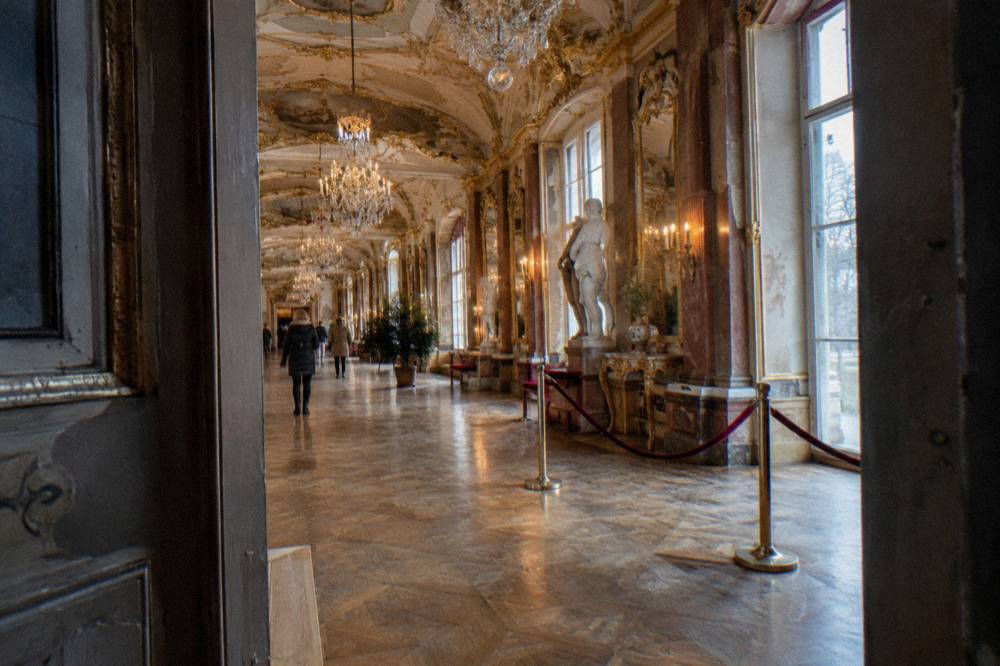
For readers who want the history with a guide rather than an audio guide, the small-group option is worth a look. The From Wroclaw: Ksiaz Castle, Tunnels & Church of Peace Tour runs about 8 hours, is rated 4.8 across 117 reviews, and costs from $145 per person with castle entry tickets included, giving the fullest historical arc from medieval fortress to wartime tunnels in one booked day.
Who Was Princess Daisy Of Ksiaz?
Princess Daisy of Pless, born British and married to Hans Heinrich XV Hochberg, was the last great mistress of Ksiaz, and she is remembered for the terraced gardens and the social world she brought to the castle in the decades before the First World War. Her presence still shapes the visitor experience: the castle credits the British gardeners she hired for the terraces, and her apartments and story are a recurring theme of guided interior commentary.
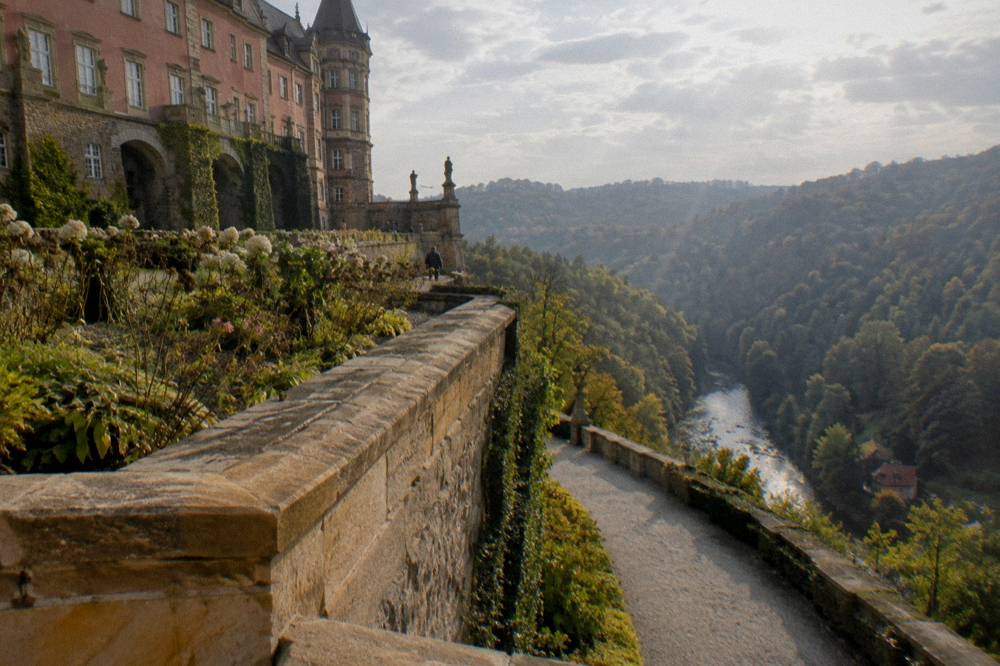
Daisy's life bridges two eras. She arrived into an aristocratic world of hunting parties and imperial visits, and lived to see that world disappear, her estate bankrupted, and the castle she loved pass out of family hands entirely. Her memoirs made her one of the most widely read aristocratic voices of her generation, and her name remains the castle's strongest emotional hook for visitors, the human face of an otherwise architectural story.
The official castle narrative leans into her legacy deliberately, with Daisy-themed tours and references through the interiors. Her story is told in more detail in what happened to Princess Daisy, while the wider question of the estate's fate after her is covered in who owns Ksiaz Castle now. Wikipedia's Ksiaz Castle history article gives the same outline for readers who want a second telling.
What Happened To Ksiaz Castle In World War Two?
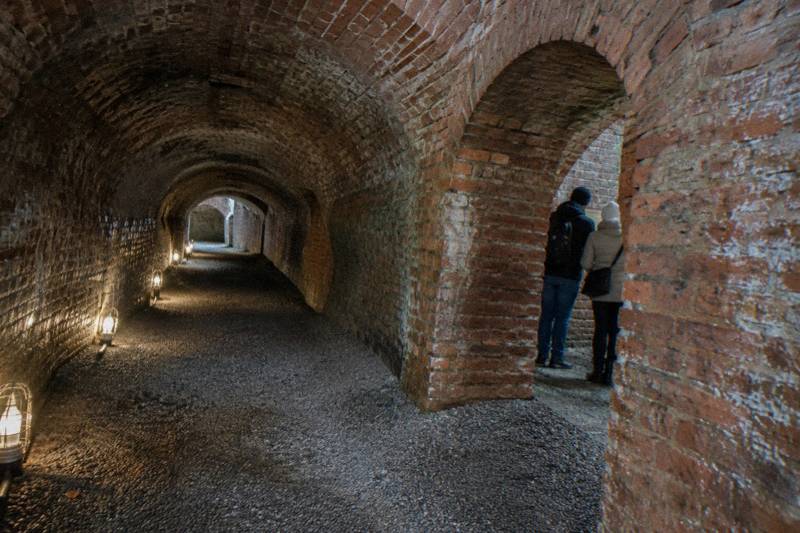
During the war the Nazi government seized Ksiaz Castle, evicting the Hochberg line, and from 1943 to 1945 the site became part of Project Riese, a vast tunnelling programme that gutted the interiors and drove concrete tunnels under the hill using forced labour. The castle survived the war physically, but its cellars, some floors and much of its interior fabric were destroyed or rebuilt during the project, which never reached completion.
Project Riese, the German word for giant, was a codename for a network of seven underground complexes in the Owl Mountains, of which the Ksiaz tunnels were one component alongside sites such as Osowka and Wlodarz. The exact intended purpose was never documented and remains debated, with theories ranging from a command headquarters to armaments production. What is documented is the labour: prisoners from Gross-Rosen concentration camp subcamps did the digging, and thousands died doing it. The castle's own underground route presents this history factually and respectfully.
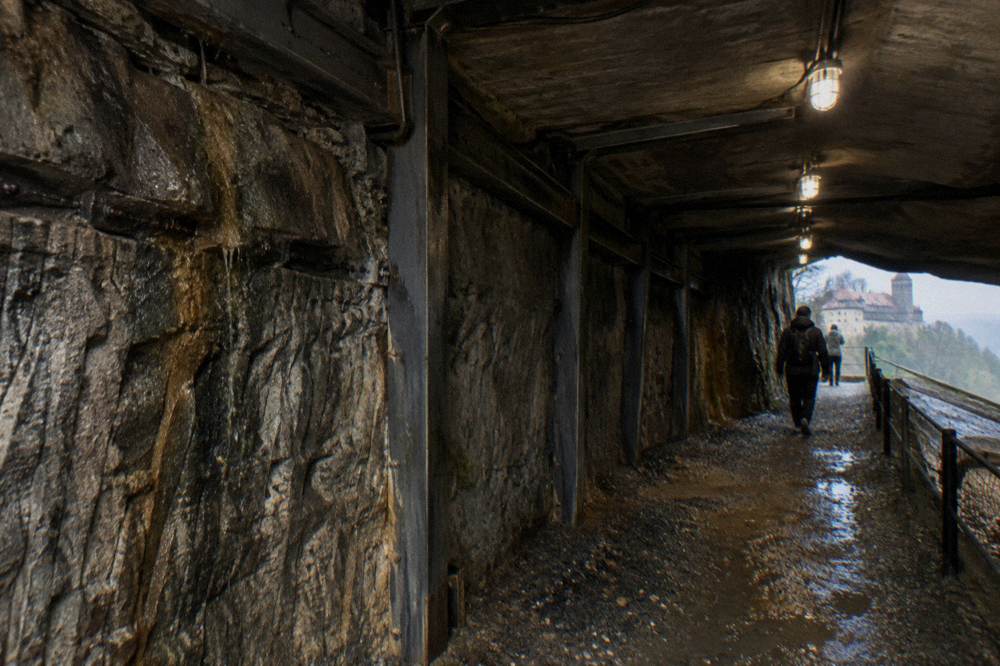
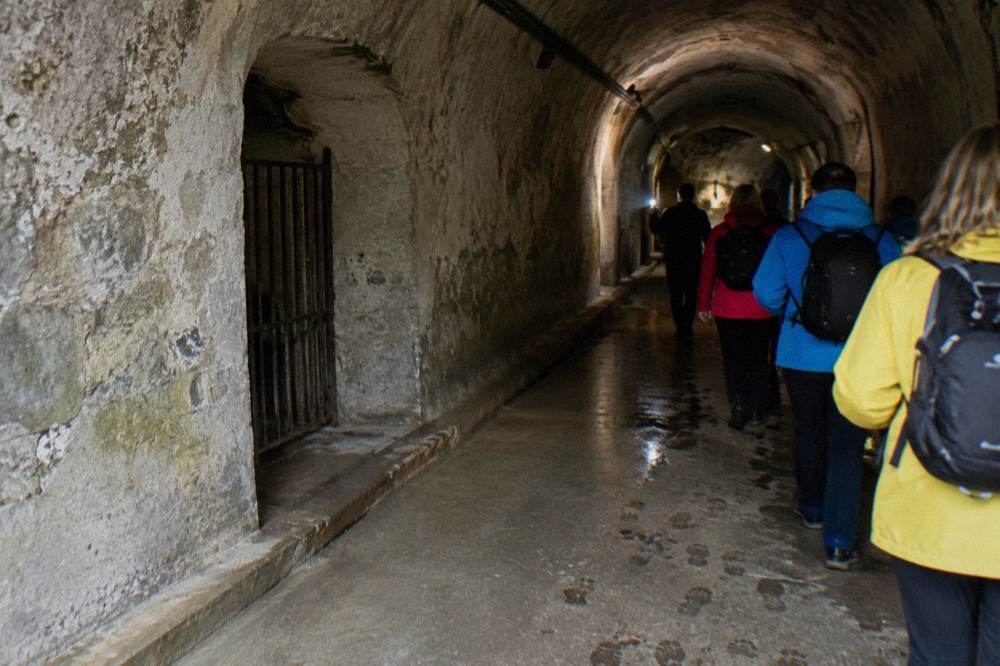
For visitors, the wartime layer is the one you can physically walk through. The official underground route page describes a guided tour of about 40 minutes at roughly 6 C, with Polish-language guiding and an audio-guide supplement in other languages, and children under 4 are not admitted. A combined castle-plus-underground-plus-Palm-House ticket costs 92 PLN normal or 82 PLN reduced, and underground-only entry costs 45 or 39 PLN. The deeper background is in the Project Riese Osowka and Wlodarz guide.
Several tours from Wroclaw build the whole day around this wartime history. The Wroclaw: Project Riese and Ksiaz Castle Private Tour pairs Osowka's underground town with the castle in roughly 7 to 8 hours, is rated 4.8 across 42 reviews, and costs from $198 with castle entry tickets included and hotel pickup in Wroclaw.
How Did The Castle Survive After 1945?
After 1945 Ksiaz Castle stood in the ruins of the German-speaking world that had built it, passed through decades of Polish state use and neglect, and was eventually taken over and restored, ending up in the hands of the City of Walbrzych, which owns and operates it today through a municipal company. The postwar decades were unkind but not fatal, and restoration work gradually returned the complex to public use. With the halls open to the public once more, you may be wondering how touring actually works, and our guide to exploring Ksiaz Castle on your own explains what a simple entry ticket covers and when a guided tour is required.
The transition was cultural as much as physical. Walbrzych, a city about 70 km from Wroclaw with a population of 108,222 recorded at the end of 2021, inherited a palace built for aristocrats who would never return, inside a landscape park established in 1981 that now protects about 31.55 square kilometres of surrounding forest. The castle's modern identity as the region's flagship attraction grew from that inheritance, combining the Hochberg palace story with the wartime tunnels and a full calendar of exhibitions and events.
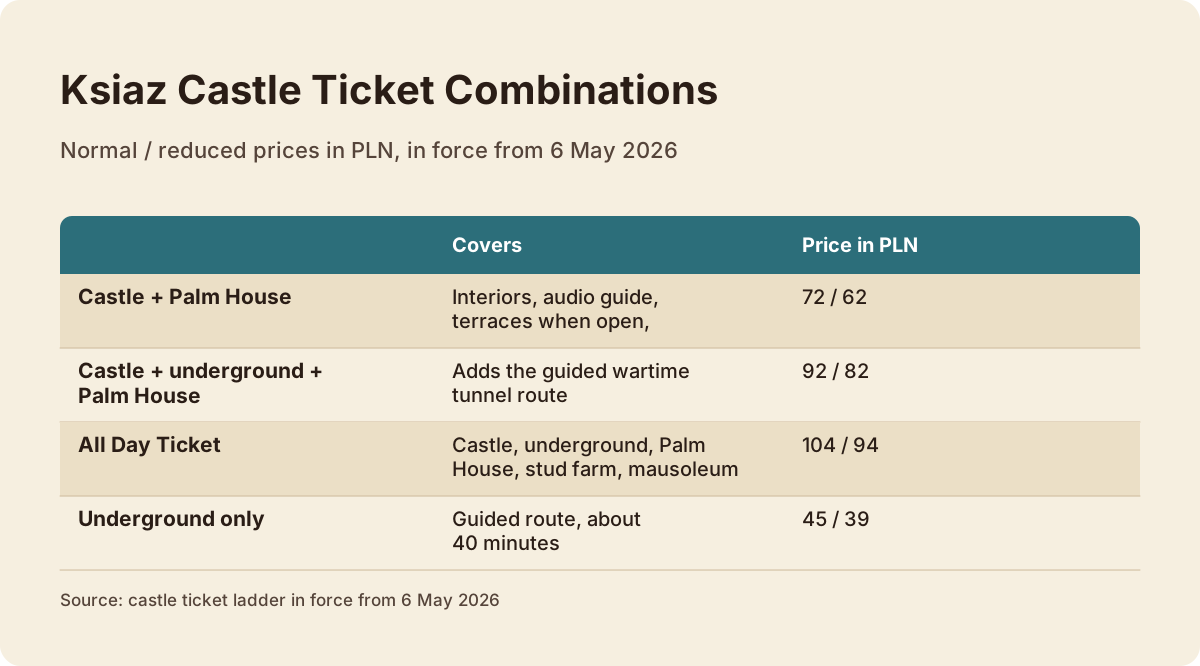
Visitors benefit directly from the city's investment. The current ticket ladder, in force from 6 May 2026, offers combinations that match each historical layer:
| Ticket | Covers | Normal / Reduced (PLN) |
|---|---|---|
| Castle + Palm House | Interiors with audio guide, terraces when open, Palm House | 72 / 62 |
| Castle + underground + Palm House | Adds the guided wartime tunnel route | 92 / 82 |
| All Day Ticket | Castle, terraces, underground, Palm House, stud farm, mausoleum | 104 / 94 |
| Underground only | Guided route, about 40 minutes | 45 / 39 |
What Can You Still See From Each Era Today?
Visitors today can see the medieval castle footprint in the lower masonry, the Hochberg baroque interiors and terraces above ground, and the Project Riese concrete tunnels below, so the full timeline from 1288 to 1945 is physically walkable in a single visit. No other major Polish castle stacks its eras this vertically, with the oldest layer buried under the newest.
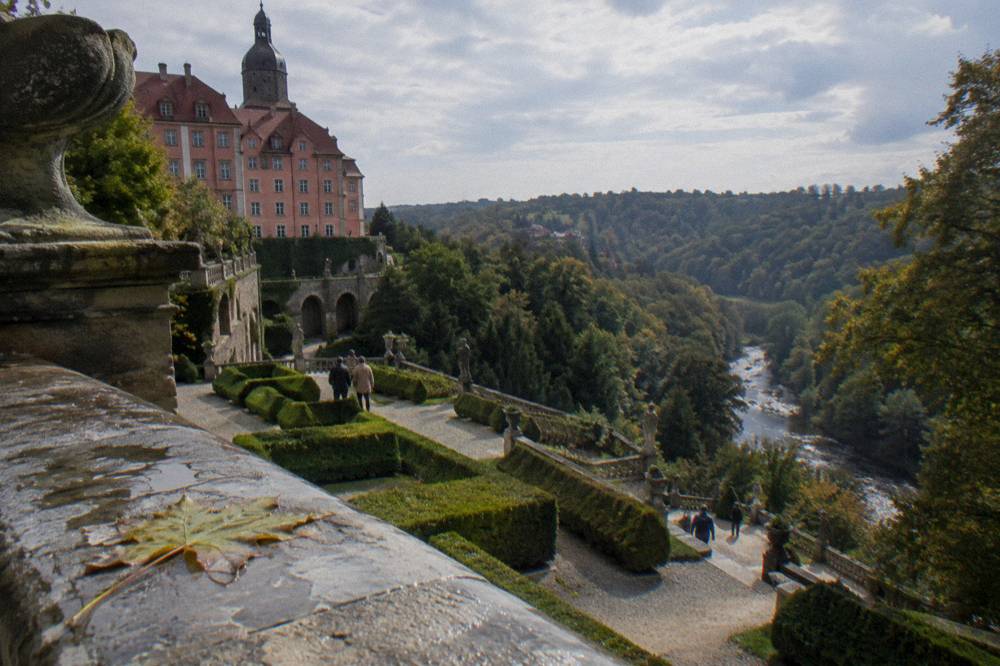
Reading the building takes a little preparation. The audio-guided castle route concentrates on the Hochberg rooms, where stucco, portraits and the grand circulation spaces tell the dynastic story. The terraces and gardens carry the Daisy era, with planting and stonework restored to echo the prewar estate. The underground route is pure Project Riese, raw rock and reinforced concrete, ending at a collapsed elevator shaft intended to rise to the honour courtyard. Daytime guided tours for individuals run in Polish at 11:00 and 14:00, while English and German commentary comes by audio guide.
How much time to allow depends on how many layers you want, and the how long to visit guide breaks it down by ticket type. History-focused visitors usually want the combined underground ticket, which the castle tickets guide compares in full.
Which Tour Tells The History Best?
Once you've picked a tour, the where to stay near Ksiaz Castle guide helps you weigh basing yourself in Wroclaw, Walbrzych, or right on the castle grounds.
| Tour | Duration | Rating | Price | History angle |
|---|---|---|---|---|
| From Wroclaw: Ksiaz Castle Private Tour | 5 to 6 hours | 6 reviews | from $165 | Interiors and gardens, tickets included |
| Wroclaw: Project Riese and Ksiaz Castle Private Tour | 7 to 8 hours | 4.8 from 42 reviews | from $198 | Tunnels and Osowka |
| Wroclaw: Day of WW2: Riese, Gross-Rosen, Ksiaz Castle | 9 to 10 hours | 4.8 from 19 reviews | from $253 per person | Full wartime itinerary |
| From Wroclaw: Ksiaz Castle & Swidnica Church of Peace Tour | 5 to 7 hours | 4.7 from 43 reviews | from $175 | Castle plus UNESCO church |
For the deepest single-day immersion in the darker chapters, the Wroclaw: Day of WW2 tour stands out. It runs roughly 9 to 10 hours with hotel pickup, a group maximum of 8, and a route linking Gross-Rosen Museum, the Osowka underground town and Ksiaz Castle, rated 4.8 across 19 reviews and priced from $253 per person. The Gross-Rosen Museum visitor page confirms the memorial site is open daily and free to enter, which is why the camp leg of these tours costs no admission.
Readers whose interest is the palace rather than the war have a separate set of options. The Skip-the-line Ksiaz Castle from Wroclaw by Private Car tour runs 5 to 6 hours with castle entry tickets included and covers interiors, the underground route and the baroque garden in one loop, from $231, with English, German and Polish service available.
When Is The Best Time To Experience The Castle's Story?
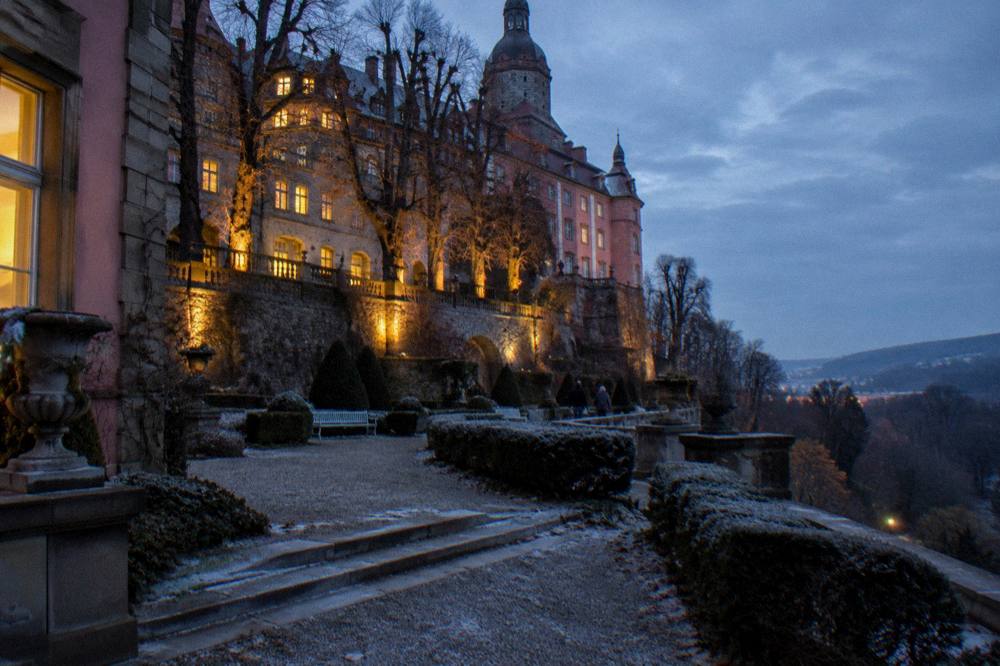
The castle tells its story differently by season: terraces and gardens carry the Daisy era from April to September, the underground route runs year round at 6 C, and from November to late February the evening Gardens of Light installation replaces the terraces entirely. Timing a visit around the right layer is part of the planning, not an afterthought.
Opening hours are published monthly rather than as a fixed annual schedule, and the current blocks matter. In November 2026 the castle interiors open 10:00 to 16:00 on weekdays and 10:00 to 17:00 on weekends, with the interiors closed entirely on 1 November while the Gardens of Light open from 17:00. The light season runs from 1 November 2026 to 28 February 2027, with terraces tickets at 45/39 PLN, Palm House at 35/30 PLN and a combined ticket at 65/55 PLN. Hours for December 2026 to March 2027 had not yet been announced, so check the castle's official page before you go, and the official sightseeing page posts each new block. Seasonal planning is covered in depth in the best time to visit guide.
The April flower festival is the other fixed point in the history-minded calendar. The TAURON Flower and Art Festival fills the castle with installations from more than 100 florists across some 40 spaces for four days at the end of April or start of May, and it requires a festival ticket for castle access on those dates. For a fuller comparison of the seasonal choices, see the Ksiaz Castle at night guide.
A final word on logistics: every tour on this page departs from Wroclaw, and independent travellers can reach Walbrzych by regional train, a connection described in the Wroclaw to Ksiaz Castle by train, bus or car guide. Whichever route you choose, book the underground time slot ahead, because guided entries are capped and the wartime layer is the one part of the history that cannot be seen any other way.
The terraces and the winter light installation are mutually exclusive: the Gardens of Light take over the terraces only after the Daisy-era season has ended, so travellers who want both will need two trips, one inside the April to September window and one inside the light season. The underground route is the one layer that ignores this rhythm, and at 6 C it deserves a jacket whatever the weather above ground.
On price, the arithmetic is simple: terraces at 45 PLN plus the Palm House at 35 PLN adds up to 80 PLN, which is 15 PLN more than the 65 PLN combined ticket.
One planning habit to adopt: because hours are posted as monthly blocks, the times noted during research may not be the ones in force on arrival day, so recheck the official sightseeing page in the days before travel, treat 1 November as an evening-only date, and if the flower festival is the goal, let its four days anchor the whole itinerary.
Common Questions About Ksiaz Castle History
Who Built Ksiaz Castle?
Duke Bolko I the Strict of the Piast dynasty built Ksiaz Castle between 1288 and 1292 as a border fortress, and the castle was first documented in writing in 1293.
How Old Is Ksiaz Castle?
The founding walls date to 1288 to 1292, though most of what visitors see today reflects later Hochberg rebuilding that began with the family's acquisition of the estate in 1509.
What Was Project Riese At Ksiaz Castle?
Project Riese was a Nazi tunnelling programme that ran from 1943 to 1945, excavating reinforced tunnels under the castle using forced labour from Gross-Rosen concentration camp subcamps. Its intended purpose was never documented.
Who Owns Ksiaz Castle Today?
The City of Walbrzych owns the castle complex and runs it through a municipal company, following the postwar nationalisation of the Hochberg estate.
Which Family Owned Ksiaz Castle The Longest?
The Hochberg family, from Konrad I's acquisition in 1509 until the wartime seizure of the estate, held Ksiaz for more than four centuries, longer than any other owners.
Can You Tour The Ksiaz Castle Tunnels?
Yes, the underground route is open to visitors on timed guided tours of about 40 minutes, with an audio-guide supplement in foreign languages. A combined castle, tunnels and Palm House ticket costs 92 PLN normal or 82 PLN reduced.